Why We Moved Clients to Headless Commerce
For years, traditional ecommerce platforms were the obvious choice for businesses that wanted to launch an online store.
You selected a platform, installed a theme, added products, configured payments and shipping, installed plugins, and started selling.
For many businesses, that approach still works.
But as ecommerce businesses grow, their requirements change.
They need faster storefronts, better customer experiences, more control over the frontend, custom integrations, personalized shopping experiences, multiple sales channels, and an architecture that can evolve without forcing the entire store into one platform.
That is where headless commerce becomes interesting.
We started moving suitable clients toward headless commerce when the limitations of traditional ecommerce architectures became more noticeable than their convenience.
The goal was not simply to use newer technology.
The goal was to create ecommerce systems that could support better performance, greater flexibility, and long-term scalability.
What Is Headless Commerce?
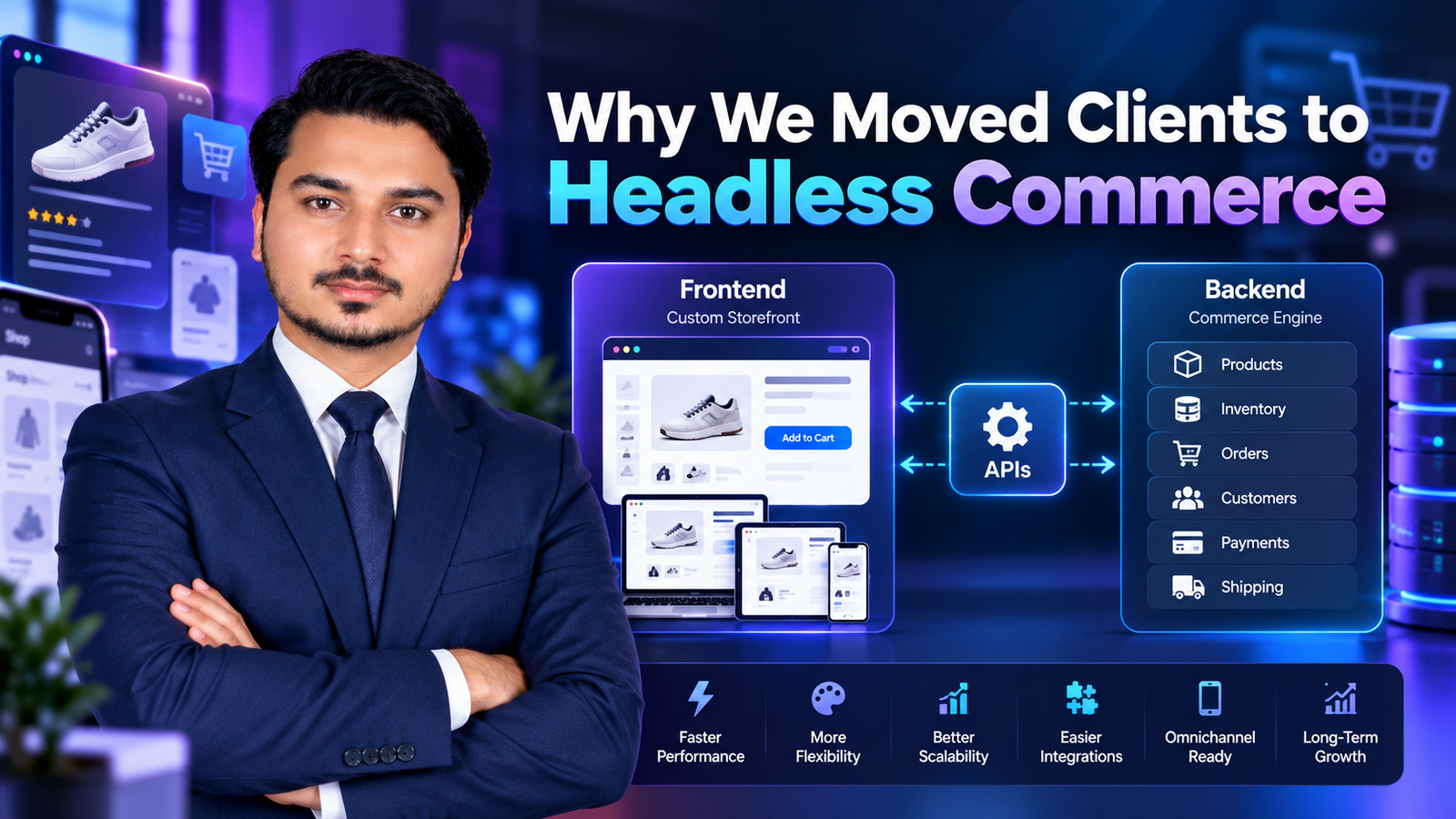
Headless commerce separates the frontend customer experience from the backend commerce system.
In a traditional ecommerce website, the frontend and backend are usually tightly connected.
The ecommerce platform controls much of the experience, including:
- Product pages
- Shopping cart
- Checkout
- Templates
- Navigation
- Content presentation
- Customer account interfaces
The architecture can look something like this:
Customer → Frontend → APIs → Commerce Backend
The frontend might be built using technologies such as React or another modern framework, while the backend can remain responsible for:
- Products
- Inventory
- Orders
- Customers
- Payments
- Pricing
- Shipping
- Promotions
Why We Started Moving Clients to Headless Commerce
The decision was rarely based on one problem.
Usually, it came from several problems appearing at the same time.
A growing ecommerce business might have a perfectly functional store but eventually run into issues such as:
- Slow page loads
- Limited theme customization
- Too many plugins
- Difficult third-party integrations
- Poor mobile experiences
- Complicated personalization
- Difficult content management
- Frontend limitations
- Scaling challenges
- Increasing technical debt
Instead, separating the frontend from the commerce engine can provide a cleaner architecture.
1. Better Frontend Performance
One of the biggest reasons for considering headless commerce is performance.
A modern ecommerce storefront can be designed specifically around performance rather than relying entirely on a platform's traditional theme architecture.
Developers can control:
- JavaScript delivery
- Component loading
- Image optimization
- Code splitting
- Caching
- Rendering strategies
- API requests
- Content delivery
- Page structure
Performance matters because ecommerce users often interact with multiple pages during a single shopping session.
A customer may visit:
Homepage → Category → Product → Cart → Checkout
If every page is unnecessarily heavy, those delays accumulate.
A faster storefront can create a smoother shopping experience and provide a stronger technical foundation for SEO and conversion optimization.
For businesses that need broader performance work across their existing website, our Website Speed Optimization service can also be applied without completely rebuilding the ecommerce architecture.
2. More Control Over the Customer Experience
Traditional ecommerce themes can be extremely useful.
But eventually, businesses often want experiences that don't fit neatly inside a predefined theme structure.
For example, a company might want:
- Interactive product configurators
- Custom product comparison
- Dynamic filtering
- Personalized recommendations
- Interactive product builders
- Advanced search
- Custom checkout experiences
- Location-based experiences
- Subscription interfaces
- Unique promotional experiences
Instead of asking:
"Can the ecommerce theme do this?"
the question becomes:
"How should we build this experience?"
That's a major difference.
3. Easier Integration With Other Systems
Modern ecommerce rarely exists as a standalone application.
An online store may need to communicate with:
- CRM systems
- ERP platforms
- Inventory systems
- Payment providers
- Shipping platforms
- Marketing automation
- Customer support systems
- Product information management systems
- Analytics platforms
- Search services
- Recommendation engines
- AI systems
For example:
Frontend
↓
Commerce API
↓
ERP + CRM + Inventory + Payment + Shipping
This can create a much more modular technology stack.
For businesses that need custom integrations, our API Integration Services are particularly relevant because APIs become a central part of the architecture.
4. We Could Choose the Right Frontend Technology
One of the biggest advantages of headless commerce is frontend freedom.
The commerce engine does not necessarily dictate how the customer-facing experience must be built.
A development team can select a frontend architecture based on the actual requirements of the business.
For example, React-based applications can provide highly interactive shopping experiences while allowing developers to carefully control rendering and client-side behavior.
This is especially useful for ecommerce businesses where the storefront itself is becoming a major competitive differentiator.
Our Frontend Development service is built around this type of modern frontend architecture.
5. Better Scalability
Scaling an ecommerce business isn't only about handling more visitors.
It's also about handling more complexity.
A growing store may eventually have:
- Thousands of products
- Multiple product categories
- Multiple markets
- Different pricing rules
- Multiple warehouses
- International customers
- Multiple payment methods
- Different shipping rules
- Several marketing channels
- Multiple internal systems
Headless architecture allows different parts of the system to evolve more independently.
The frontend can evolve without completely replacing the commerce backend.
Likewise, backend services can be changed or extended without redesigning the entire customer experience.
6. Omnichannel Commerce Becomes Easier
Customers don't necessarily interact with a brand through one website anymore.
They may discover products through:
- Websites
- Mobile apps
- Social platforms
- Marketplaces
- In-store systems
- Kiosks
- Smart devices
- Other digital experiences
For example:
Commerce Backend
→ Website
→ Mobile App
→ Marketplace
→ In-Store Application
→ Custom Customer Portal
This can reduce the need to duplicate core commerce functionality across every channel.
7. Content and Commerce Can Work Together
Modern ecommerce is increasingly content-driven.
A store may publish:
- Buying guides
- Product comparisons
- Tutorials
- Editorial content
- Videos
- Reviews
- Product education
- Landing pages
Instead of forcing every page into a traditional ecommerce template, developers can create custom content experiences that still connect directly to products and commerce functionality.
This is one reason headless architectures are often attractive to brands where content and ecommerce need to work closely together.
8. SEO Can Still Be Strong
One common misconception is that headless commerce automatically creates SEO problems.
It doesn't.
But SEO needs to be considered during architecture and development.
A headless ecommerce website needs a deliberate approach to:
- Server-side rendering
- Static rendering
- Metadata
- Canonical URLs
- Structured data
- Internal linking
- Product URLs
- Category URLs
- Pagination
- Indexation
- XML sitemaps
- Image optimization
- Page speed
SEO needs to be part of the development process from the beginning.
For businesses that need technical SEO support alongside development, our Technical SEO service can address the technical side of search visibility.
9. We Could Reduce Frontend Constraints
Traditional ecommerce platforms often provide a predefined way of doing things.
That's useful when your requirements fit the platform.
But problems start when they don't.
For example, imagine a business wants a product page with:
- Interactive product customization
- Real-time pricing
- Dynamic availability
- Product recommendations
- 3D visualization
- Custom financing options
- Personalized content
But each additional extension can increase complexity.
With headless commerce, developers can build the experience directly around the business requirements.
10. Fewer Theme-Level Limitations
Themes are one of the biggest advantages of traditional ecommerce platforms.
They're also one of their limitations.
A theme provides a starting point.
But when a business begins heavily modifying the theme, the project can become difficult to maintain.
Eventually, developers may end up dealing with:
- Custom theme overrides
- Plugin conflicts
- Complicated templates
- Legacy code
- CSS overrides
- JavaScript conflicts
- Platform-specific limitations
The frontend becomes an application rather than simply a customized theme.
That can provide a much cleaner foundation for highly customized ecommerce experiences.
Headless Commerce Is Not Always the Answer
This is important.
We don't recommend headless commerce simply because it is technically interesting.
For a small business with:
- A limited product catalog
- Simple checkout requirements
- Minimal customization
- Few integrations
- A straightforward storefront
Headless becomes more compelling when the business has meaningful reasons to separate the customer experience from the commerce backend.
That might include:
- Complex integrations
- Highly customized UX
- Large catalogs
- Multiple channels
- Advanced personalization
- Performance requirements
- International expansion
- Custom product experiences
- Long-term platform flexibility
The Cost Question
One of the biggest misunderstandings about headless commerce is that it is always cheaper.
It isn't.
A headless implementation can require more development work initially.
You may need to build:
- Frontend components
- API integrations
- Product templates
- Cart functionality
- Search
- Filtering
- Authentication
- Customer accounts
- Analytics
- Caching
- Deployment infrastructure
The potential benefit is greater control and flexibility over the long term.
For businesses that expect to keep evolving their ecommerce experience, that flexibility can become valuable.
For businesses with simple requirements, the additional complexity may not be justified.
The Architecture We Prefer
A typical modern headless ecommerce architecture can look something like this:
Customer
↓
Modern Frontend
↓
API Layer
↓
Commerce Platform
↓
Products / Orders / Customers / Inventory
Alongside that, additional systems can connect through APIs:
CRM
ERP
Payment
Shipping
Analytics
Search
Marketing
CMS
The important part isn't the number of technologies.
The important part is having clearly defined responsibilities between systems.
Performance Should Be Designed, Not Added Later
One lesson we learned from ecommerce development is that performance should not be treated as a final-stage optimization task.
It should influence architecture from the beginning.
That means thinking about:
- Image sizes
- Rendering strategy
- JavaScript bundles
- API requests
- Caching
- CDN delivery
- Third-party scripts
- Fonts
- Database queries
- Search performance
- Mobile devices
Performance is an architectural concern.
Headless Commerce and Mobile Experiences
Another advantage is that the same commerce backend can support different frontend experiences.
A business could have:
Web Store
+
Mobile Application
+
Customer Portal
+
Internal Sales Interface
while keeping core commerce data centralized.
This can be particularly useful for businesses that are expanding beyond a single ecommerce website.
For organizations that require a completely separate mobile experience, a similar approach can be extended through Mobile App Development.
How We Approach a Headless Commerce Project
We don't start by choosing a framework.
We start by understanding the business.
Step 1: Understand the Existing Architecture
We look at:
- Current ecommerce platform
- Product catalog
- Integrations
- Traffic
- Performance
- SEO
- Checkout
- Customer experience
Step 2: Identify the Actual Problems
Not every limitation requires a headless rebuild.
Sometimes optimizing the existing platform is enough.
Step 3: Define the Commerce Layer
We identify what should remain inside the commerce platform and what should be handled by external services.
Step 4: Plan the Frontend
We define:
- Page architecture
- Components
- Rendering
- Navigation
- Search
- Product experience
- Checkout flow
Step 5: Build API Integrations
The frontend needs reliable communication with the commerce backend and other services.
Step 6: Optimize Performance
Performance is tested throughout development rather than only at launch.
Step 7: Test SEO
We check:
- Crawlability
- Metadata
- Canonicals
- Structured data
- Internal links
- Rendering
- Indexation
- Page speed
Step 8: Launch Gradually
For larger ecommerce businesses, a phased migration can reduce risk compared with replacing everything at once.
When Should a Business Consider Headless Commerce?
You may want to consider a headless approach if your current ecommerce platform is becoming a constraint rather than an enabler.
Some warning signs include:
- Your storefront requires extensive theme customization.
- Performance is becoming difficult to improve.
- You need multiple frontend experiences.
- Your business depends on several external systems.
- You need highly customized product experiences.
- Your development team is fighting platform limitations.
- Your ecommerce roadmap requires functionality the current theme cannot easily support.
- You are expanding into multiple channels or markets.
The Future of Ecommerce Is More Modular
Ecommerce platforms are increasingly becoming collections of specialized services rather than one giant system responsible for everything.
Commerce handles commerce.
CMS handles content.
Search handles search.
CRM handles customer relationships.
ERP handles business operations.
The frontend handles the customer experience.
APIs connect everything together.
This modular approach is closely related to the broader idea of composable commerce.
Instead of depending on one system for every requirement, businesses can assemble a technology stack around their actual needs.
Final Thoughts
We didn't move clients to headless commerce because traditional ecommerce stopped working.
Traditional ecommerce remains a practical solution for many businesses.
We moved suitable clients toward headless architecture because their requirements had evolved beyond what a tightly coupled storefront could comfortably provide.
For the right business, headless commerce can provide:
- Greater frontend control
- Better performance opportunities
- More flexible integrations
- Improved scalability
- Multi-channel capabilities
- More customized customer experiences
- Greater architectural flexibility
That's why the right question isn't:
“Should every ecommerce website become headless?”
The better question is:
“Does this business have requirements that justify a headless architecture?”
When the answer is yes, headless commerce can provide a strong foundation for building an ecommerce experience that is designed around the business rather than limited by the storefront.
If you're planning a new ecommerce platform or considering a migration from an existing system, you can explore our Ecommerce Development services, Custom Web Application Development, or API Integration Services.
You can also book a consultation to discuss whether a headless architecture makes sense for your specific ecommerce requirements.
Frequently Asked Questions
What is headless commerce?
Headless commerce separates the ecommerce frontend from the backend commerce platform. The two communicate through APIs, allowing businesses to build a more customized customer-facing experience.
Is headless commerce better than traditional ecommerce?
Neither approach is universally better. Traditional ecommerce can be suitable for straightforward stores, while headless architecture can be useful when a business needs extensive customization, integrations, performance control, or multiple customer-facing channels.
Is headless commerce more expensive?
It can require a higher initial development investment because the frontend and integrations often need to be built separately. The long-term value depends on the complexity and growth requirements of the business.
Does headless commerce help SEO?
Headless commerce can support strong SEO, but SEO must be intentionally implemented. Rendering, metadata, structured data, canonical URLs, internal linking, crawlability, and performance all need to be handled correctly.
Can Shopify be used with headless commerce?
Yes. Shopify can be used as a commerce backend while a separate frontend communicates with it through APIs. The exact architecture depends on the project's requirements.
Is headless commerce suitable for small businesses?
It can be, but it isn't always necessary. A traditional ecommerce platform may be more practical when the store has straightforward requirements and doesn't need extensive customization.
What is the difference between headless and composable commerce?
Headless primarily describes the separation of the frontend from the backend commerce system. Composable commerce generally takes the modular concept further by combining multiple specialized services to create the overall commerce stack.
Should we migrate an existing ecommerce website to headless?
Migration should be based on actual business and technical requirements. If the current platform is performing well and meeting business needs, a complete migration may not be necessary. If the existing architecture is creating significant limitations, headless may be worth evaluating.