Building RAG Assistants That Actually Scale
Retrieval-Augmented Generation, commonly known as RAG, has become one of the most practical approaches for building AI assistants that can work with private, proprietary, and frequently changing information.
A basic RAG prototype is relatively easy to build. You collect documents, split them into chunks, generate embeddings, store those embeddings in a vector database, retrieve relevant information, and provide that context to a language model.
The real challenge begins when the assistant needs to work in production.
As the number of documents, users, queries, data sources, and integrations increases, a simple RAG pipeline can become slow, expensive, inconsistent, and difficult to maintain.
Building RAG assistants that actually scale requires more than connecting an LLM to a vector database. A production-ready system needs reliable data ingestion, intelligent chunking, effective retrieval, access control, evaluation, monitoring, caching, and an architecture that can grow without requiring a complete rebuild.
What Is a RAG Assistant?
A RAG assistant combines information retrieval with a large language model.
Instead of depending entirely on the knowledge contained within an AI model, a RAG system retrieves relevant information from an external knowledge source and provides that information to the model when generating an answer.
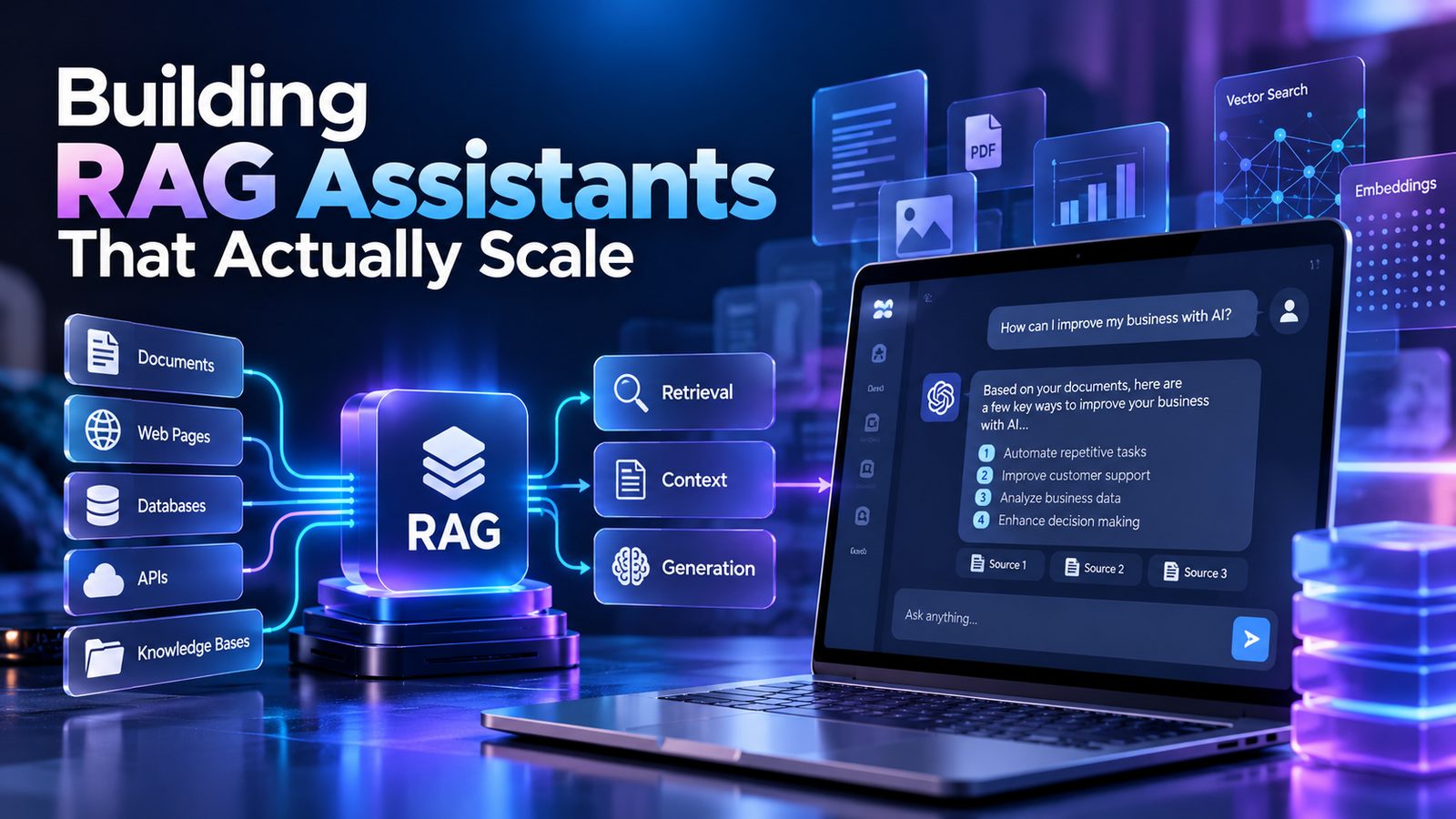
A simplified RAG workflow looks like this:
- A user asks a question.
- The system analyzes the query.
- The query is converted into a searchable representation.
- Relevant information is retrieved.
- Retrieved information is filtered and ranked.
- The best context is provided to the language model.
- The model generates an answer.
- The response is returned to the user.
Why Simple RAG Systems Stop Scaling
A small RAG prototype can work extremely well with a few hundred documents and a limited number of users.
Problems usually appear when the system grows.
Common scaling problems include:
- Slow document ingestion
- Poor chunking
- Irrelevant search results
- Too much retrieved context
- Increasing API costs
- Slow response times
- Duplicate documents
- Outdated information
- Weak access control
- Lack of evaluation
- Difficult debugging
- Inconsistent answers
The retrieval strategy, data pipeline, application architecture, and evaluation process all need to be designed for scale.
The Architecture of a Scalable RAG Assistant
A production RAG assistant can be divided into several major layers:
- Data sources
- Document ingestion
- Document processing
- Chunking
- Embedding generation
- Vector and keyword search
- Retrieval and ranking
- Context construction
- Language model generation
- Application layer
- Monitoring and evaluation
This separation makes the system easier to test, optimize, replace, and scale as requirements change.
For larger AI applications, this architecture can also be integrated into a broader custom web application rather than operating as an isolated chatbot.
Start With Reliable Data Ingestion
A RAG assistant is only as useful as the information it can retrieve.
If the ingestion pipeline produces incomplete, duplicated, outdated, or poorly structured information, the retrieval system will inherit those problems.
Data can come from many sources, including:
- PDF documents
- Websites
- Knowledge bases
- Product documentation
- Company databases
- CRM systems
- Cloud storage
- Internal applications
- APIs
- Customer support systems
This becomes especially important when RAG is part of a larger custom application with multiple data sources and business workflows.
Document Processing Matters More Than Most Teams Expect
Uploading documents directly into a vector database is not enough.
Before indexing, the system should understand what the document contains and preserve useful information about its structure.
Depending on the source, document processing may include:
- Text extraction
- HTML cleanup
- PDF parsing
- Table extraction
- Metadata extraction
- Duplicate detection
- Language detection
- Content normalization
- Document classification
- Version tracking
For example, a system may need to know whether a document belongs to a particular customer, department, product, language, or version.
Design a Better Chunking Strategy
Chunking is one of the most important decisions in a RAG architecture.
If chunks are too large, retrieval can return excessive information and consume unnecessary context.
If chunks are too small, important relationships between sentences, paragraphs, and concepts can be lost.
There is no universal chunk size that works for every RAG application.
A better strategy considers:
- Document structure
- Paragraph boundaries
- Headings
- Sections
- Tables
- Lists
- Semantic relationships
- Expected user queries
Product documentation may need relationships between product names, specifications, features, and descriptions to remain intact.
The goal is not simply to create smaller pieces of text. The goal is to create retrievable units of meaningful information.
Use Metadata Alongside Embeddings
Embeddings are powerful for semantic retrieval, but embeddings should not be responsible for everything.
Metadata provides another layer of precision.
Useful metadata can include:
- Document ID
- Document type
- Category
- Author
- Publication date
- Updated date
- Product ID
- Customer ID
- Department
- Permission level
- Language
- Version
- Does this document belong to this customer?
- Is this information current?
- Does the user have permission to access it?
- Does this result belong to the correct product?
- Is this the latest version?
Semantic Search Is Not Always Enough
One common mistake in RAG development is assuming that vector similarity should handle every query.
Semantic search is excellent for understanding conceptual similarity, but exact terms can sometimes be more important.
Consider a user searching for:
- A product code
- An invoice number
- An error code
- A customer ID
- A technical identifier
- A specific SKU
That is why production RAG systems can combine:
- Vector search
- Keyword search
- Metadata filtering
- Hybrid retrieval
- Result reranking
Improve Retrieval With Reranking
Retrieving the top results from a vector database does not necessarily mean those results are the best context for the language model.
A reranking stage can evaluate retrieved candidates and determine which pieces of information are most relevant to the actual query.
A typical retrieval pipeline can therefore look like:
- Analyze the user query.
- Retrieve candidate documents.
- Combine semantic and keyword results.
- Apply metadata filters.
- Rerank candidates.
- Select the strongest evidence.
- Build the final context.
- Send that context to the language model.
Control the Amount of Context
More context does not automatically mean better answers.
Providing a language model with dozens of loosely related chunks can make it harder to identify the information that actually matters.
A scalable RAG system should therefore focus on context quality rather than context quantity.
Useful techniques include:
- Retrieving fewer but stronger results
- Reranking retrieved content
- Removing duplicate information
- Combining related chunks
- Compressing unnecessary context
- Filtering irrelevant metadata
- Prioritizing authoritative sources
Build RAG Around Source Authority
Not every document should have equal importance.
A knowledge base may contain an official product document, an old internal article, a customer-generated note, and a draft document discussing the same topic.
The retrieval system should understand source authority.
You can use metadata and ranking rules to prioritize:
- Official documentation
- Current information
- Verified internal sources
- Approved knowledge bases
- Authoritative product information
Handle Document Updates Correctly
Real-world information changes constantly.
Products change. Policies change. Documentation changes. Prices change. Customer information changes.
A scalable RAG system therefore needs a reliable update strategy.
Instead of rebuilding the entire vector index every time one document changes, the ingestion system should identify what changed and update the relevant records.
Useful techniques include:
- Document versioning
- Content hashes
- Incremental indexing
- Change detection
- Deletion handling
- Document expiration
- Selective re-indexing
Design for Multi-Tenant RAG Applications
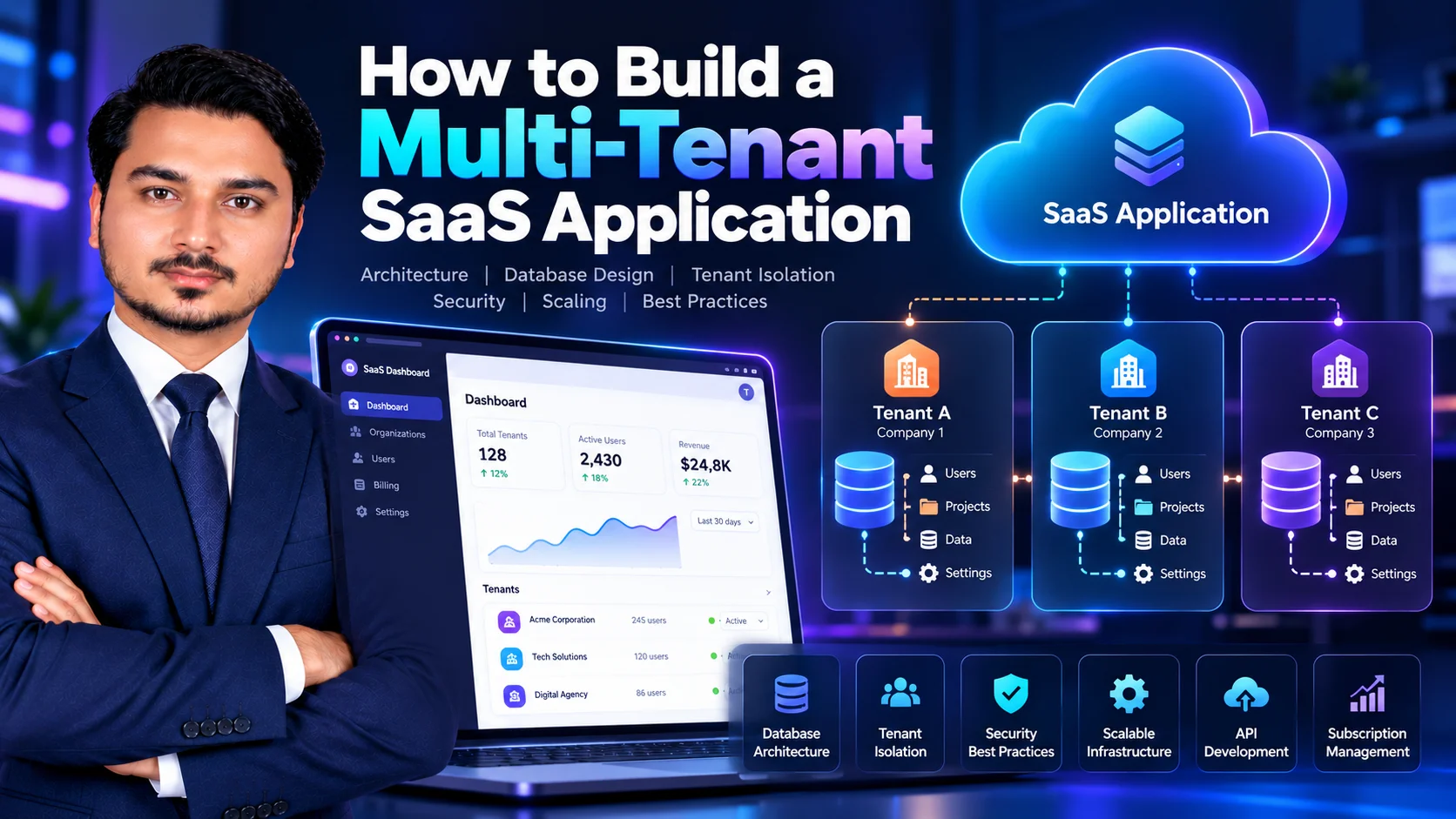
If you are building a SaaS product where multiple organizations use the same AI assistant, data isolation becomes extremely important.
A customer's documents should never accidentally appear in another customer's retrieval results.
Multi-tenant RAG systems should therefore consider:
- Tenant IDs
- User permissions
- Metadata filters
- Document ownership
- Role-based access
- Authentication
- Authorization
- Audit logging
Filtering sensitive information after retrieval is not an adequate replacement for properly designed authorization.
Connect RAG With Business Systems
The real value of a RAG assistant often comes from connecting it with the systems where business information already exists.
For example, an assistant could retrieve information from:
- CRM systems
- Internal knowledge bases
- Product databases
- Documentation platforms
- Customer portals
- Business applications
- Internal APIs
A well-designed API integration layer can allow the RAG assistant to retrieve current information instead of relying exclusively on a static document collection.
This is especially useful for businesses where information changes frequently.
RAG and AI Chatbots
RAG is particularly useful for AI chatbots that need to answer questions using business-specific information.
Common use cases include:
- Customer support assistants
- Internal company assistants
- Product support bots
- Documentation assistants
- Sales assistants
- Employee knowledge assistants
- Technical support systems
The retrieval, authorization, ingestion, evaluation, and monitoring layers determine whether the assistant performs reliably in production.
An AI chatbot that looks impressive during a demo can still fail when exposed to thousands of real queries and constantly changing information.
Keep the RAG Pipeline Asynchronous Where Possible
Not every RAG operation needs to happen while the user is waiting for a response.
Document processing, embedding generation, indexing, and maintenance operations can often be handled asynchronously.
This allows the user-facing application to remain responsive while background workers process larger workloads.
A scalable architecture may separate:
- User requests
- Document ingestion
- Embedding generation
- Index updates
- Evaluation jobs
- Maintenance tasks
Use Caching Strategically
Caching can reduce both latency and infrastructure costs.
Some requests are repeated frequently, especially in customer support and internal knowledge systems.
Depending on the application, you may be able to cache:
- Frequently requested answers
- Query embeddings
- Retrieval results
- Document metadata
- Expensive intermediate operations
A stale answer can be worse than a slower answer.
Evaluate Retrieval Separately From Generation
One of the most important practices in production RAG development is separating retrieval quality from answer-generation quality.
If an assistant produces an incorrect answer, several different problems could be responsible.
The correct document may never have been retrieved.
The wrong document may have been ranked too highly.
The retrieved context may have been incomplete.
The language model may have misunderstood the context.
The prompt may have failed to constrain the response.
The source itself may have contained incorrect information.
Without separate evaluation, it becomes difficult to determine where the actual problem exists.
Create a Real RAG Evaluation Dataset
Production systems should not rely only on manual testing.
Create a collection of representative questions and expected evidence.
These questions should represent the different ways real users interact with the assistant.
Your evaluation dataset can include:
- Simple factual questions
- Multi-step questions
- Ambiguous questions
- Exact-match queries
- Long-form questions
- Questions with missing information
- Permission-sensitive questions
- Questions requiring multiple documents
- Chunking
- Embedding models
- Retrieval strategy
- Reranking
- Prompts
- Data processing
- Language models
Monitor RAG in Production
Once a RAG assistant is live, monitoring becomes essential.
You should be able to understand what happened when a user receives a poor answer.
Useful metrics include:
- Response latency
- Retrieval latency
- Number of retrieved documents
- Token usage
- Model cost
- Error rates
- Search failures
- Cache hit rates
- User feedback
- Answer quality
Optimize RAG Costs
Scaling an AI assistant is not only a technical challenge. It is also a cost-management challenge.
Costs can come from:
- Embedding generation
- Vector database usage
- Language model requests
- Reranking
- Document processing
- Storage
- Data transfer
- Background processing
Reducing unnecessary context, caching repeated operations, avoiding duplicate embeddings, and selecting appropriate models for different tasks can all help control costs.
Design RAG for Failure
A production AI assistant should not assume that every query will have a good answer.
Sometimes the required information simply does not exist in the knowledge base.
The assistant should be designed to recognize when the available evidence is insufficient rather than confidently generating unsupported information.
A reliable system should be able to:
- Identify insufficient evidence
- Ask a clarifying question
- Explain when information is unavailable
- Return a controlled fallback
- Escalate to a human when appropriate
Security Should Be Part of the Architecture
RAG systems often process internal or sensitive information, which makes security an architectural concern.
Important considerations include:
- Authentication
- Authorization
- Tenant isolation
- Secure API communication
- Secret management
- Access-controlled retrieval
- Audit logging
- Data retention
- Input validation
Retrieved information should be treated as data and handled carefully rather than automatically trusted as system-level instructions.
Keep the RAG Architecture Modular
A scalable RAG application should not be tightly coupled to one model, one database, or one retrieval technique.
A modular architecture makes it easier to replace individual components as requirements evolve.
For example, you may eventually want to replace:
- The embedding model
- The vector database
- The language model
- The reranking system
- The document parser
- The authentication provider
- The search strategy
Modularity gives development teams much more flexibility as the system grows.
RAG for SaaS Products
RAG can become a powerful feature inside SaaS products.
A SaaS platform can provide each customer with an AI assistant that works with that customer's own documents, processes, products, and knowledge base.
However, SaaS RAG introduces additional requirements around:
- Tenant isolation
- Usage limits
- Billing
- Data management
- Monitoring
- Security
- Scalability
Common RAG Scaling Mistakes
Several mistakes repeatedly appear when teams move RAG applications from prototype to production.
Using Only Vector Search
Semantic search is useful, but exact identifiers and structured filters may require additional retrieval methods.
Using Fixed Chunk Sizes Everywhere
Different document types often require different chunking strategies.
Retrieving Too Much Context
More retrieved content can increase cost and make it harder for the model to identify relevant information.
Ignoring Metadata
Metadata can improve filtering, authorization, freshness, and retrieval precision.
Skipping Evaluation
A RAG system that works during a demo can still fail badly with real-world queries.
Ignoring Data Freshness
Old documents can produce outdated answers if the ingestion pipeline does not properly manage updates and deletions.
Putting Everything Into One Service
Tightly coupled architectures become increasingly difficult to maintain as data volume, users, and integrations increase.
A Practical Scalable RAG Architecture
A practical production architecture can be organized into the following flow:
Data Sources → Ingestion → Processing → Chunking → Embeddings → Retrieval → Reranking → Context Construction → LLM → Application → Monitoring
Each stage has a specific responsibility.
Data sources provide the information.
The ingestion layer collects it.
The processing layer cleans and structures it.
The chunking layer prepares meaningful retrieval units.
The embedding system creates searchable representations.
The retrieval layer finds relevant information.
Reranking improves the relevance of retrieved candidates.
Context construction prepares the evidence for the language model.
The LLM generates the response.
The application delivers that response to the user.
Monitoring and evaluation continuously measure the quality and performance of the system.
This separation allows individual components to scale independently when necessary.
How to Build a RAG Assistant That Scales
If you are starting a new RAG project, a practical development process can look like this:
- Define the exact use case.
- Identify authoritative data sources.
- Design the document ingestion pipeline.
- Normalize documents and metadata.
- Develop an appropriate chunking strategy.
- Implement semantic and keyword retrieval where appropriate.
- Add metadata filtering.
- Introduce reranking when necessary.
- Build controlled context construction.
- Connect the language model.
- Create an evaluation dataset.
- Implement monitoring and logging.
- Test security and authorization.
- Load-test the application.
- Optimize cost and latency.
- Deploy gradually and continue measuring performance.
When Should You Build a Custom RAG Assistant?
A custom RAG assistant can make sense when a business needs to work with proprietary information that generic AI tools cannot reliably access or understand.
Common use cases include:
- Internal company knowledge
- Customer support
- Technical documentation
- Product knowledge
- Employee training
- Policy documents
- Research databases
- Enterprise knowledge management
- AI-powered SaaS products
Final Thoughts
Building a RAG assistant is relatively easy.
Building one that actually scales is a much bigger engineering challenge.
The difference between a prototype and a production-ready RAG system is usually not the language model alone. It is the architecture surrounding the model.
Reliable ingestion, intelligent chunking, metadata, hybrid retrieval, reranking, context control, access management, evaluation, monitoring, caching, and cost optimization all contribute to the quality of the final system.
The most scalable RAG assistants are designed as systems rather than demos.
When the architecture is modular, measurable, secure, and built around high-quality retrieval, an AI assistant can grow from a small proof of concept into a production application without requiring the entire system to be rebuilt.
Ready to Build an AI-Powered Application?
If you are planning a RAG assistant, AI-powered SaaS platform, internal knowledge assistant, or custom AI application, you can explore my development services to see how I can help with the technical implementation.
You can also book a consultation to discuss your project requirements, architecture, integrations, and development goals.
If you already have a project in mind, you can contact me directly to discuss the next steps.
Frequently Asked Questions
What is a RAG assistant?
A RAG assistant is an AI application that retrieves relevant information from external data sources and provides that information to a language model to help generate a response.
What makes a RAG system scalable?
A scalable RAG system typically uses modular architecture, efficient ingestion, optimized retrieval, metadata filtering, caching, asynchronous processing, monitoring, evaluation, and appropriate infrastructure.
Is vector search enough for RAG?
Vector search is useful for semantic retrieval, but many production systems benefit from combining vector search with keyword search, metadata filtering, and reranking.
How does chunking affect RAG performance?
Chunking determines how information is divided for retrieval. Poor chunking can cause relevant context to be missed or produce unnecessarily large retrieval results.
Can RAG assistants work with private company data?
Yes. RAG can connect AI assistants with private documents, knowledge bases, databases, and business systems while applying appropriate access controls.
How can RAG reduce AI hallucinations?
RAG can provide the language model with relevant external evidence instead of relying entirely on its internal knowledge. However, retrieval quality and application design still determine how reliably the system uses that information.
Can RAG be used in SaaS applications?
Yes. RAG can be integrated into SaaS applications to provide customer-specific AI assistants, knowledge search, support automation, documentation assistants, and other AI-powered features.
How do you evaluate a RAG assistant?
A RAG system should be evaluated using representative queries and measurements for retrieval quality, answer quality, latency, cost, source relevance, and failure handling.